Pages

Showing posts with label Instruments. Show all posts

Monday, December 10, 2018

Historical Instruments from China (Part 3)

Hello, again lovely people. Today I will be again talking to you about ancient instruments from China, and I promise you that this will be the last part. Well, I hope you enjoy and learn something. Buckle up because your gonna be looking at some amazing instruments. These are also my favourite ones so I will be putting demonstrations of it.

1. Guqin
Image result for Guqin
Credit: Wikipedia
Guqin, the oldest musical instrument in China, it is also known as the Seven-stringed instrument. The body of the Erhu is a long and narrow wooden sound box. It is usually 130 centimetres long, 20 centimetres wide and 5 centimetres high. The surface is commonly made of paulownia wood or China fir and has seven strings drawn along it. On the edges are 12 inlaid jade markers. Catalpa wood is used for the base, and there are two holes, one big and one small, which are named the 'Phoenix pool' and 'Dragon Pond', to emit the sound.

The fingering abilities are known as a recital, rubbing, plucking, concentration, floating notes and harmonious notes. The instrument is mellow in tone colour with airy and floating notes, which can be called the sound of harmony. The most unique part of the Guqin probably lies in its performance etiquette. Before giving a performance, players should take a shower and burn aroma in the room. They are to keep their minds tranquil and concentrated to ward of foul spirits.

The Story Of Guqin

During the Spring and Autumn Period (770BC - 476BC), there was a man named Yu Boya, who was a popular music master at that time. He happened to meet Zhong Ziqi. No matter what kind of piece of music Yu played, Zhong could understand very well, therefore, they became bosom friends. They agreed on a meet at the same place in the following year. Unfortunately, Zhong died before they could ever meet. Yu played at Zhong's graveyard for the last time and crashed his Guqin. He decided never to play the Guqin any more to show his deep friendship to Zhong and how difficult to meet a bosom friend.

2. Erhu 
Erhu is a set of bowed instrument, is the most symbolic instrument in the Chinese traditional folk musical instrument. As one of the most popular Chinese string instruments, the two-stringed vertical fiddle has a sustained history of more than 1,000 years.  Competent of making a powerful and eerie sound, Erhu is extremely popular in China today. 
Image result for erhu
Credit: DHgate.com

Although recognised as a Chinese violin, Erhu is quite diversified from its western counterpart. There is a vertical post with the fingerboard across the sides of a resonator at its base. This resonator is covered with a piece of stretched python skin that produces a unique 'whining' tone. The Erhu bow is located between its two strings namely in the inner and outer strings. Traditionally the two strings are made of silk, but metallic strings are also handled. An Erhu performer regularly sits with the instrument on his or her left upper thigh in front of the left hip. The Erhu's range spans over three octaves and the tune shares some features with the violin, although it produces a more nasal tone, which is gentle but firm.  

The tone of Erhu resembles a human voice. Besides, it can intimidate many natural sounds, such as bird and horse. As a very expressive instrument, Erhu can play not only melancholy tunes but also joyful melodies. Erhu is usually employed in national orchestras. In smaller orchestras, there are usually two to six Erhu's, in larger ones there are ten to twelve. 


3. Chinese Chimes

Chinese Chimes
Credit: topchinatravel.com
Chinee Chimes are a large-scale musical instrument in China, which arose in the Western Zhou Dynasty (1046BC - 771BC), and reached heyday during the Warring States period (770BC- 221BC). Chinese Chimes are made flat with sharp corners like two tiles pieced together. So the sounds wane faster, making it possible to organize the bels into groups and play them as a rhythm instrument.  Zeng Houri's Bronze Chimes, thousands of years from now, are perhaps the greatest find among all the chimes unearthed so far in terms of the size and importance.

The bells fill a 60-square meter area and a total weight of five tons. The heaviest one is 203.6 kilogram and is 1.5 meters tall, while the smallest one is 2.4 kilogram and 20.4 centimetres high. Tests have shown that each bell can provide two different high-pitched notes, depending on where they are fastened.

The instrument has a range of five octaves and is one of the earliest instruments with 12 semitones. After  2,500 years in the tomb, the instrument can still play ancient music. The beautiful pitch produced can be modulated, giving some idea of the musical complexity available even in the early times. Acoustic tests have found that the mixture of tin and lead in the bronze instrument fits with modern metallurgy. Even today, making such bells is by no means an easy job, especially big ones. 

The unearthed instruments not only have accurate tonality but also are inscribed with elaborate patterns such as humans, beasts, dragons and words making tones of each bell, indicating the ancient Chinese had already mastered and advanced bronze making techniques at that time. It is presumed that the complexity of manufacture prevented the chimes from getting popular and the technique disappeared after the Han Dynasty (206 BC - 220BC). 


4. Pipa
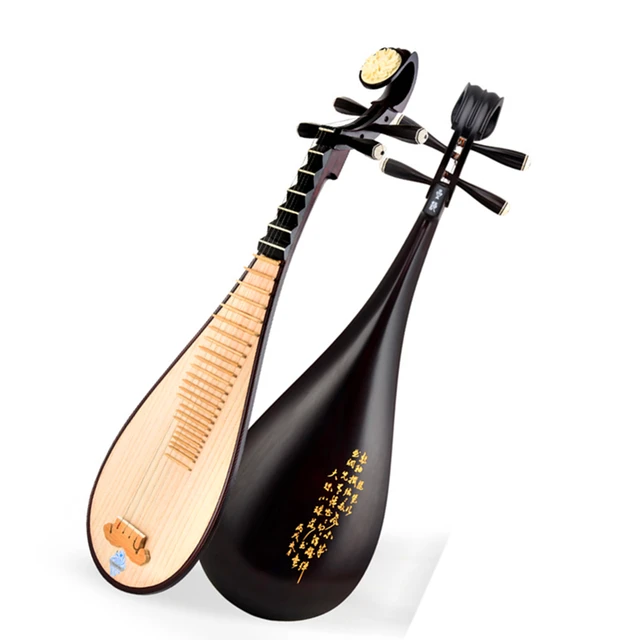
Image result for Pipa
Credit: AliExpress.com
Pipa is a four-stringed lute with 30 frets and a pear-shaped body. The musician holds the instrument upright and plays with five small plectrums attached to each finger of the right hand. The history of Pipa dates back at least 2,000 years. This instrument has an extremely wide dynamic range and is remarkably vibrant and warm.

The original Pipa comes to us from the second century BC. Poetry and drawings portray an instrument held horizontally and named for the forward and backward plucking of the strands.

The Pipa has a long history with the Chinese people. Compositions were passed from master to student over hundreds of years. While many of these compositions have been lost over time, several still exist to delight listeners today. As the Chinese people rediscover their history, so too has there been a reemergence in interest in classical instruments such as the Pipa. Some contemporary performers have even started to also integrate the music with western sounds to create a new generation of Pipa music.


5. Guzheng
Image result for Guzheng
Credit: Wavesfactory 
Chinese Zither/Guzheng is one of the traditional musical instruments in China. It's a kind of plucked instrument. It originated during the Warring Period more than 2,500 years ago in China. The earliest known version was constructed with a bamboo frame and use silk strings. Its scale was pentatonic using notes DO, RE, MI, SO and LA with a major note for each of its five string. Because Guzheng was developed in a region called Qin Guo, its name became known as the Qin Zheng.

Guzheng became very popular in the imperial court and among the common people. Historical records from an ancient book and scholarly writings give vivid accounts of the instrument and its music. Hou Jin, a scholar of the Eastern Han Period (25 AD - 220 AD) wrote that Guzheng's sound touches the heavens above and the gods and spirits below.

By the Tang Dynasty (618 AD - 907 AD), the number of strings had increased from five to thirteen, and the bamboo had been replaced with wu-tong or paulownia wood for the frame of the instrument. In addition, many new forms of Guzheng appeared through cultural exchanges with Japan, Korea, Mongolia, Vietnam and many other Asian countries.

Guzheng remained popular through the late Qing Dynasty (1644AD - 1911AD), where contemporary Guzheng musicians began the first attempts to formalize Guzheng music by compiling and arranging both classical and popular works such as 'High Mountain and Flowing Water' and 'The Homebound Fisherman'. In 1948, the renowned musician Cao Zheng established the first university-level Guzheng program in China. The old silk strings were replaced with nylon strings, which are still being used today. The music played by the GUzheng suits both refined and popular tastes, and it's still popular musical instrument in China.


Reflection: I have to say I did extremely well because I had to replace the other words with my own words. Next time try to include a diagram. 

Well, everyone, that was the last. I hope you have learnt something and I also hope you find this interesting. Anyways have a great day, bye!

Wednesday, December 5, 2018

Historical Instruments From China (Part 2)

Hello, Lovelies, today I will be again talking/explaining to you ancient instruments from China. I hope you enjoy and learn something!

1. Xiao
Image result for xiao instrument
Credit: DHgate.com
Xiao is one of the oldest musical instrument in China. It's a kind of wind instrument, it enjoyed a time honoured history. The melody of the vertically-played bamboo flute or Xiao in Chinese reminds people of a lonely moon highly hanging in the sky of a frosty autumn night. The sound of it is the sound of nature, the timber is soft and elegant.

The earliest Xiao appeared during the Han Dynasty which was around 206BC - 220AD, and it was then called Qiangdi, which was popular among the Qiang people in Sichuan and Gansu Provinces. in the 1st century BC, it became popular in the Yellow River region. Later, it was developed into an instrument with six holes and today's Xiao developed to eight holes.

2. Xun
Image result for Xun
Credit: Sound of Mountain Music
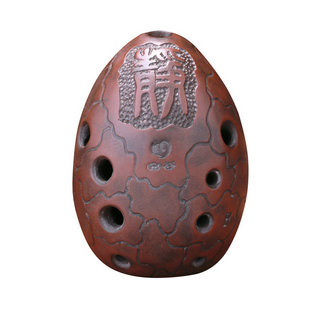
Xun is a kind of wind instrument. It is one of the oldest musical instruments found so far in China with a history of more than 7,000 years, and play an important role in world music circle. The instrument has been found along the Yangtze River and the Yellow River as Neolithic relics, and I believed very popularly in ancient China. the ancestors use a kind of oval stone with naturally formed holes on it to hunt preys. When thrown it at the animals, the stone produces a whistling sound as the air flowing through the hole, which could have provided inspiration for early wind instruments.

Xun is easily made of clay with an egg shep and there are no more than ten holes on the surface. it can produce sound with a tamber similar to that human voice and is suitable for performing some lamenting aria. it is often accompanied by the Chi, a bamboo pipe with eight holes.

3. Drum
Image result for ancient drum chinese big
Credit: DHgate.com
China, Mesopotamia, ancient Egypt, are regarded as the home of a drum. As a traditional percussion instrument, drum occupies a prominent place in Chinese culture. According to the ancient literature, it might be as old as Chinese History itself.

The existing earliest documentation of its application occurs in Oracle Inscriptions of the Shang Dynasty which is around 16000 BC - 1100 BC. As an old and wonderful form of art, the frum has been employed in almost every aspect of Chinese social life, including sacrificial and worshipping ceremonies, farming and warfare.


4. Dizi
Image result for Dizi
Credit:Amazon.com
Dizi is a kind of ancient Chinese instrument and is the most representative musical instrument with strong ethnic characteristics. Dizi is always performed on occasions, such as Chinese traditional orchestra, a western symphony orchestra and so on. It's regarded as in inseparable part of wind instruments.

Most of Dizi is made of bamboo Dizi has a nice sound effect. For many Chinese people, the melody of the transversely-played bamboo flute calls to mind a picture of a country cowherd riding a bull in the spring breeze. The gnarls in the long bamboo pipe have been eliminated. There are one blowing hole, one affiliated hole and six sound holes. the blowing hole is the first hole of the Dizi/Flute, where the air s blown to make sounds. Next one is the affiliated hole which is cover by the membrane of the bamboo or bulrush.

5. Waist Drum
waist drum
Credit: Top China Travel
Waist Drum, is a traditional Chinese Drum, mainly popular among people in north China, especially in Shanxi Province. Waist Drum is usually played by a man as the instrument shows a muscular feature of men and often accompanied by dancing movements as well. Given this nature of easy dancing when playing at the same time, the waist drum is commonly used in the Yangge dancing as well.


6. Suona
Image result for Ancient Suona
Credit: Pinterest
The suona was first introduced to ancient China from Persia. it is one of the typical Chinese traditional. instruments. it is also commonly called laba (meaning horn in Chinese) in China and bayin (meaning eight tunes) in Guangdong Province. the suona has a distinctively loud sound and is used in many Chinese traditional music bands. it is quite common instruments in northern China, particularly the provinces of Shandong, Shanix and Henan.


Reflection: I think I did very well explaining what they are, what they are made of and how they sounded. Next time learns more and finds out if they are still popular or not.

Hey, lovely people hope you have enjoyed reading and learning some Chinese ancient history. I hope you all learned something has a great day Bye!


Monday, December 3, 2018

Historical Instruments From China

Image result for clarinet
Credit: Thoman
Clarinet: Reed Instrument
Hello, again fellow viewers today I will be telling you about historical instruments from China. This is only part one, so I am gonna put 6 here and some more in the next one. Anyways I hope you enjoy and learn a lot of things.

Information/History:
Classical Chinese assumed that music would purify people's minds. More than 30,000 years ago has 70 types of melodious (musical) instruments. During that time, the royal family and aristocrats had their own orchestra, this displays their wealth, power, position, and taste distinguished on peasants. However, music was never limited to the upper social class, the music trend solemnity turned into entertainment.

Huge and complex instruments like the Bronze Chimes gave way to more lively and easy-play wind and reed instruments. The Tang Dynasty, one of the strongest one of the strongest and most prosperous empires in Chinese history, was a golden age for musical development. Many of the Tang emperors were musicians or composers themselves.

Chinese traditional musical instruments can be mainly classified into three categories, string, wind, and percussion.

Now we are done with all the history I will be telling you/showing you some ancient instruments.

1. Pan Flute

Image result for pan flute
Credit: The Whisper

The Pan Flute is a traditional musical instrument especially frequently used in folk song or melodies. It is also known as panpipes or syrinx in the west. In China, pan flutes are often made with bamboo, normally from 10 to 24 bamboo pipes with different lengths tied together and each one is tuned to one keynote. The pan flute is played by blowing horizontally across an open end against the sharp inner edge of the pipes. 


2. Morin Khuur

Image result for morin khuur
Credit: Sound of Mountain Music
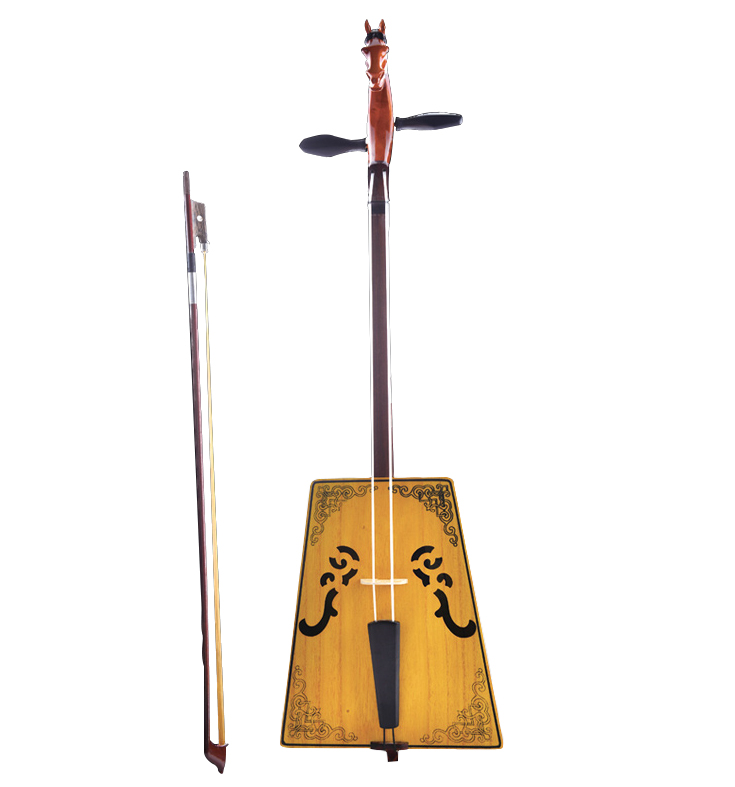
The Morin Khuur was also known as the 'Horse Head Fiddle', is a traditional Mongolian stringed instrument which is very popular among the Mongolian people in north China. It is the most loved and iconic musical instruments of the Mongol people. The origin of Morin khuur goes that once  Wrangler's favourite colt (Toddler horse)(?) was dead, in memory of his colt he made an instrument with his body.

The design of the Morin Khuur is closely linked to the all-important cult of the colt/horse. The instruments hollow trapezoid-shaped body is attached to a long fretless neck bearing a carved horse head at its extremity. Just below the head, two tuning pegs jut out like ears from either side of the neck. the soundboard is covered with animal skin and the bow is made out of horse hair.

3. Hulus
hulus
Credit: Top China Travel 
The hulus, known as cucurbit flute or bottle gourd silk in the west, is a free reed wind traditional Chinese instrument. It is most popular among the ethnic group living in Yunnan and the nearby provinces in southwest China, especially among the Dai People the word Hulu is implying meaning gourd and si means silk, representing the unique sound of hulus is as soft and beautiful as a quality silk.

Hulus normally has 2 or 3 pipes made of bamboo which pass through a gourd wind chest, the centre pipe has a finger hole in the main pipe. Given it is easy to learn, Hulus ha gain popular among tourist both domestic and overseas.

4. Lu Sheng

Image result for lu sheng
Credit: ChinaHao.com
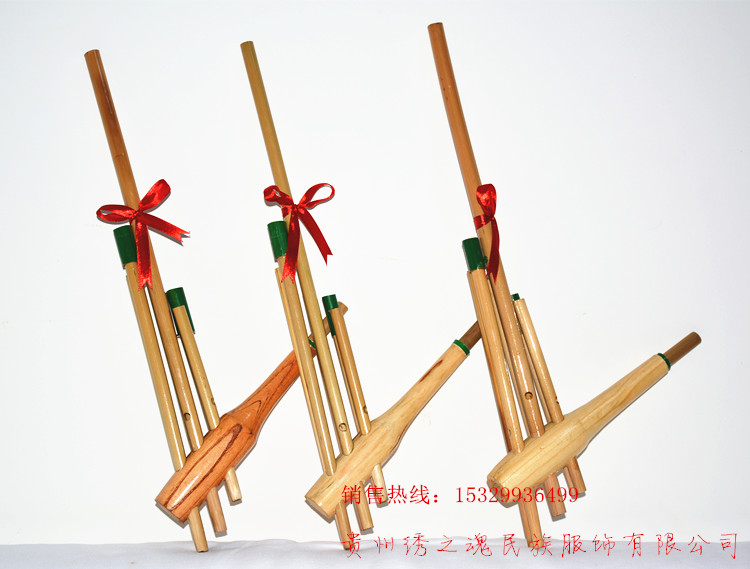
Lu Sheng is a wind instrument for MiaoYao and Dong ethnic people living in southwest China. It has been originated in central China with a history of over 3000 years, then it went quite popular among those ethnic group people in south-west where is mainly today's Guizhou province. During the Tang Dynasty, the excellent Lu Sheng masters from the southwest part of ancient China had come to the capital city to perform their skin to please the emperor and had attained highly appreciation. 


5.Sheng
Image result for sheng
Credit: Wikipedia 
Sheng, one of the oldest musical instrument in China, is a kind of wind instrument, and it's the oldest musical instrument used reed in the world. It has played an active role in promoting the development of Western musical instruments. In 1978, Pao Sheng, the earliest form of Sheng were unearthed in Hubei Province in a royal tomb with a history more than 2,400 years ago. The development of the Sheng can be traced back to 3,000 years ago. The instrument is quite similar in form to another kind of instrument called the Paixiao.

Sheng originally consisted of several bamboo pipes bound together with ropes or wooden frames. To make Sheng distinguishable from Paixia, designers added bamboo reed and cup-shaped Dou to it. The cup-shaped Dou is made of Calabash, and the blowtorch is made of wood. A dozen bamboo pipes are arranged on top of the Dou. After the Tang Dynasty, performers began to make wooden Dou. Later, Dou and the reed were made of copper.

6. Dombra
Image result for dombra
Credit: Wikipedia
Dombra is a traditional instrument in the Kazak ethnic group people in west China. It is a long-neck two strings instrument. The tune of Dombra is never too loud and the skill is mainly obtained by the Kazak people, therefore the sound of it represents a very distinctive regional colour. It is particularly quite good at playing quick melodies due to its unique picking skills.

Reflection: Well, I think I did very well, I worked really hard. Next time I should include a diagram to explain how to use it. 

Well, that is all, for now, I hope you learned something, stay tuned for more. Until next time, I hope you have a great day, Bye!