Pages

Showing posts with label Philippine Independence day. Show all posts

Tuesday, June 9, 2020

Philippine Independece Day!

Magandang Umaga, sa lahat! (Good Morning to everyone!) This is week is the Filipino Cultural week, and at the end of the week is the Filipino Independence week. We are currently learning about Filipino Independence Day. I hope you learn a lot of new things about my culture!

Filipino Independence Day:

The Filipino Independence day is held on the 12th of June, it marks the day where the Philippines officially left the Spain colony, this happened on June 12th 1898. The Filipino Independence day is called Araw ng Kalayaan, which means "Day Of Freedom".

Flag: The Philippines flag can be hanged vertically or horizontally, there are meanings in the colours and symbols of the flag.

When the red side of the flag is at the top it means that we are in a war, when the blue one is at the top it means we are at peace.
Flag of the Philippines - Wikipedia

During the independence day, Filipino children will be scattered around the streets playing traditional games while the adults will be cooking foods for the celebrations. For tourists, I would recommend them to visit national Museums to learn about the Filipino culture and history behind our Independence Day.

 In celebrations, we sing karaoke and be free, whenever celebrations sing the national anthem make sure sing it with respect by putting your right hand on your heart.

Filipinos cook a lot so that means we also eat a lot. Some foods we eat are:
Halo-Halo
Sinigang
Adobo
Lechon
Kare-Kare
Caldereta (Spicy beef stew)
Banana Que

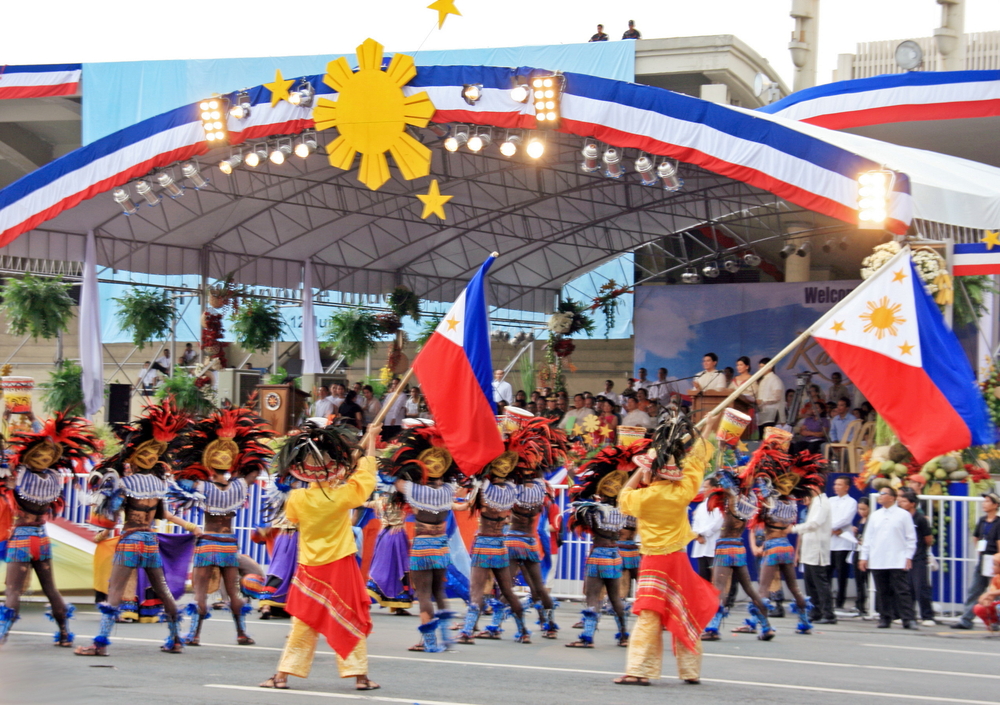
Here are some pictures on people on the Filipino Independence Day.

Why celebrate the Philippine Independence Day? | Philippine ...

Thursday, June 13, 2019

Filipino Cultural Week: Day 3 - Folk Dances

Hello everyone! Welcome back to another post, I am here with the details on what we did on day three of the Filipino Cultural Week. On Wednesday (day 3) we performed fold dances as you can see from the title. There was a total of seven performances, half of them are from year 7&8's. Here is a list of the dances, though I do not have any pictures of videos of the performances I have some examples of the dance.

1. Tableau

We first opened the performance by representing some history from the Phillippines. If you saw my post about the Filipino Cultural Week you may have seen that on June 12 is the Philippine Independence meaning that on Wednesday was the official day for Independence Day. So it was a really special day, Tableau is a performance where you do not speak and sometimes not move. In our performance, we did a little dance and acted one of the history's that happened around 121 years ago.

2. Handog/Handog ng Filipino sa Mundo. (Meaning: The Gift of Filipinos to the world.)

Handog is actually a song and that song meant that we are together and we thank the people who made us a free country.

Here is the song:
 

Lyrics + Translation 
‘Di na ‘ko papayag mawala ka muli. (I won't allow losing you again)
‘Di na ‘ko papayag na muli mabawi, (I won't allow them to take it back)
Ating kalayaan kay tagal natin mithi. (Our freedom which we have been longing)
‘Di na papayagang mabawi muli. (I won't allow them to take you back)

Magkakapit-bisig libo-libong tao. (connected arms, thousands of people)
Kay sarap palang maging Pilipino. (How sweet it is to be Filipino)
Sama-sama iisa ang adhikain. (All together, one intention)
Kelan man ‘di na paalipin. (Never again will be enslaved)

Ref:
Handog ng Pilipino sa mundo, (Gift of Filipinos to the world)
Mapayapang paraang pagbabago. (Peaceful means of change)
Katotohanan, kalayaan, katarungan (Truth, freedom, justice)
Ay kayang makamit na walang dahas.(Can be achieved without violence)
Basta’t magkaisa tayong lahat. (Let's just all be united)

Masdan ang nagaganap sa aming bayan. (Observe what's happening in our country)
Magkasama ang mahirap at mayaman. (The rich and poor are together)
Kapit-bisig madre, pari, at sundalo. (Connected arms nuns, priests and soldiers)
Naging Langit itong bahagi ng mundo. (This part of the earth became heaven)

Huwag muling payagang umiral ang dilim. (Do not permit darkness to reign again)
Tinig ng bawat tao’y bigyan ng pansin. (Pay attention to the voices of the people)
Magkakapatid lahat sa Panginoon. (We are all siblings in God)
Ito’y lagi nating tatandaan. (We should always remember this)

Coda:
Mapayapang paraang pagbabago.
Katotohanan, kalayaan, katarungan.
Ay kayang makamit na walang dahas.
Basta’t magkaisa tayong lahat!
I do not want to lose you again. (I will not allow you to lose it again)
'I do not want to regain it, (I will not allow them to return it)
We are aware of the freedom of our time. (Our freedom to which we wish)
'Will not be allowed again. (I will not allow them to return you)

Come close to thousands of people. (connected arms, thousands of people)
For those who love Filipinos. (Very good of being Filipino)
There is one common cause. (All together, one intention)
Man is not a slave. (Never again slavery)

Ref:
Filipino gift to the world, (Philippine gift of the world)
Peaceful change. (Peaceful means of change)
Truth, freedom, justice (Truth, independence, justice)
Can be achieved without violence (Can be achieved without violence)
We're all together. (We are all together)

See what's happening in our town. (Observe what's happening in our country)
Together the poor and rich. (The rich and poor are together)
Head nurse, priest, and soldier. (Connected weapon nuns, priests and soldiers)
It became Heaven part of the world. (This part of the earth has become heaven)

Do not re-pay the existing one. (Do not allow darkness again)
Everyone's voice is noticeable. (Pay attention to people's voices)
All of you will be in the Lord. (All of us are brothers in God)
It's always remembered. (We should always remember it)

Coda:
Peaceful change.
Truth, freedom, justice.
Can be achieved without violence.
We're all together!

3. Cariñosa


Cariñosa is a Philippine folk dance it is similar to Spanish dance. It represents love affection of your significant other. Cariñosa uses a fan and a handkerchief, it plays an instrumental role as it places the couple in a romantic scenario. The most common movement in the dance is the hide and seek movement. It uses the boy's handkerchief to represent fondness and sentiment.


4. Subli


Subli was originally made in Batangas, it a Filipino folk dance.  The term Subli has owed
its meaning to two Tagalog words ‘subsub’ means faceplanting and ‘bali’ which means
broken. Therefore the dancers appear to be lame and crooked. Subli is the dance portion
of devotion in honour performed in honour of the Mahal ng Poong Santa Cruz.


5. Itik Itik

Itik-itik is a mimetic folk dance in The Philippines. It originated in the province of Surigao in Mindanao. In Itik-itik (from the Tagalog word for "duck"), the dance steps imitate the movements of ducks among rice paddies and swamplands, such as wading, flying, and short, choppy steps.


6. La Jota Moncadena

The Jota Moncadena is the interpretation and adaptation by the old people of Moncada, Tarlac (Province in the Philippines). Hence, the dance is named after the place from where it originated. It is a combination of Spanish and Ilocano( Province in the Philippines) dance steps and music. The use of bamboo castanets makes the dance lively and delightful.


7. Last but not least is Tinikling!

Tinikling is the nations folk dance, it is classified as the most famous dance in the Philippines. In tinikling, you need two bamboo sticks and wood for a platform. The dance is done gently slamming the bamboo down on the wood and then clapping it together to make a beat. Then there are two people, girl and boy who put their feet in the middle of the wood/bamboo and dance to the beat while stepping in the middle of the bamboo while it is slamming down on the wood.

Though it is not as complicated at this.


Wednesday, June 12, 2019

FIlipino Cultural Week: Day 2 - Filipino Games

Hello everyone! Welcome to another post, on Tuesday, it was day 2 of the cultural week. In that day we did some Filipino games. We played 3 games, Tumbang Preso, Chinese Garter and Patintero. Here are the rules and how to play each game.

Tumbang Preso:
Image result for tumbang preso
Credit: Philippines Wiki - Fandom  
In English 'Knock down the Prisoner', also known as Tumbang Lata 'Knock down the can' or Bato Lata 'Hit the can with a stone'. It is a traditional Filipino children's game, where you get shoes or slipper and try to knock the can down. There is a person that is 'it' and but to decide which person is 'it' the people need to throw there slipper or shoes. The one which is the furthest is the person that is it.

So what the other people are supposed to do is simply knock down the can. When you throw the slipper/shoes you need to quickly retrieve before the tagger/it tag's you. But if you cannot retrieve the slipper, another person will help retrieve it by throwing the slipper. As for the tagger/it, if a slipper lands close to the can, they have to put one of their foot on the can and the other on the slipper near the can. If you get tagged by the tagger/it you will become the new tagger.

Chinese Garter:
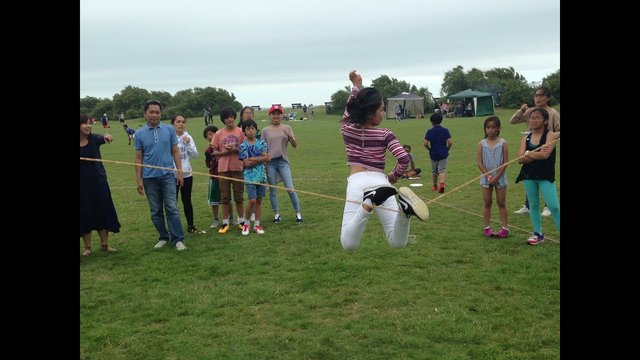
Image result for Chinese garter
Credit: Steemit
As you can see from the title it says Chinese, but this isn't from China. Chinese Garter is a Philippine traditional game. In this game, you will need to be flexible and you need to be able to jump quite high. So the first thing is we need to have garter or a string, you will need one or you can get one whole string and connect it together to get two strings.

The objective of the game is to crosswise over the garter without being tripped. The Chinese Garter is generally subdivided into ten levels.

Level 1: The garter is near the ground.
Level 2: Knee High
Level 3: Around the height of the hips
Level 4: Waist High
Level 5: Chest High
Level 6: Shoulder High
Level 7: Head High
Level 8: At the tip of the head
Level 9: A couple centimetres over the head.
Level 10: Also known as the mother/father jump, as high as a child raising his/her arms high on tippy toes.

Patintero:
Image result for patintero
Credit: Go Outside and Movement 

Patintero is played on a rectangular grid drawn into the ground. The rectangle is usually 5 to 6 m (16 to 20 ft) in length, and 4 m (13 ft) wide. It is subdivided into four to six equal parts by drawing a central lengthwise line and then one or two crosswise lines. The size of the rectangle and the number of subdivisions can be adjusted based on the number of players. The individual squares in the grid must be large enough that someone can stay in the middle out of reach of someone standing on the lines.

Now you need a few taggers that will go in the line, they cannot move from the line, they can only move sideways. The objective of the game is to run back and forth in the rectangle without getting tagged. 


Tuesday, June 11, 2019

Filipino Cultural Week: Day 1 - Filipino Greetings

Hello everyone! Welcome to another post, today I will be sharing with you what we did on day 1. So yesterday (Monday), we taught people how to greet people in Filipino. So the first we learned was how to say hello.

English
Tagalog
Hi/How are you?
Kumusta (po) - Polite Way
(Ka-mus-ta)
Good morning
Magandang Umaga
(Ma-gan-dang-U-ma-ga)
Good afternoon
Magandang Hapon
(Ma-gan-dang-Ha-pon)
Goodnight
Magandang Gabi
(Ma-gan-dang-Ga-bi)
Thank you
Salamat (po) - Polite way
(Sa-la-mat)
You're Welcome
Walang Anuman
(Wa-lang-A-nu-man)

Here's a little chart of what we taught, hope you learned something! That is all for now!

Filipino Cultural Week!

Hello lovely people! Welcome to another post, today we are celebrating the Filipino cultural week! This week will be full of joy and happiness.  In this week we will be hosting games, learning a few words
and performing, this is to celebrate the Filipino Independence day.

If you don't know Philippine Independence day is a day where we celebrate our declaration of independence from Spain. All this happened on June 12, 1898.

Some history........

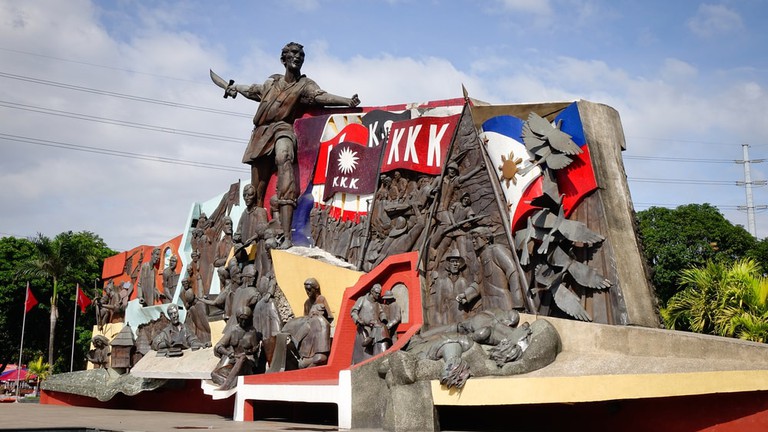
Philippine Independence day is a day of war and love varied through the nation's history. The earliest recorded was when Andres Bonifacio, along with Emilio Jacinto,  Restituto Javier, Guillermo Masangkay, Aurelio Tolentino, Faustino Manalak, Pedro Zabala and a few other Katipuneros went to the Pamitinan Cave in Montalban, Rizal to initiate new members of the Katipunan.


Image result for kkk philippines
Credit: theculturetrip.com
'Bonifacio wrote Viva la Independencia Filipina! or Long Live Philippine independence on walls of the cave to express the goal of their secret society. Bonifacio also led the Cry of Pugad Lawin, which signals the beginning of the Philippine Revolution. Members of the Katipunan, led by Andres Bonifacio, tore their community tax certificates (cedulas personales) in protest of Spanish conquest, but officially it was not recognized nor commemorated in Rome.'

-----

On 1964, June 12 was observed as Flag Day in the country/ In 1965, President Diosdado Macapagal issued Proclamation No. 374, which moved Nation Flag day to May 28 (the date the Philippine flag was first flown in the battle of Alapan located in Imus, Cavite in 1898.  


That was a lot of history wasn't it? Right so what we do on that day, is we celebrate, celebrate our freedom,  what we do to celebrate is we dance, folk dances like Cariñosa, Tinikling etc....

Well, that is probably all I have to say, we will officially be performing on Wednesday (School time), and Friday evening, from 6pm to 8pm. Come to Hornby High School Auditorium, to learn about a new culture enjoy performances.