Hey everyone, we are on our second pe hurumanu and in this hurumanu, we will be learning a New Zealand native game. Ki o Rahi, let's start with some background history and some information about the game. Hope you enjoy and learn something!
Showing posts with label Traditional. Show all posts
Showing posts with label Traditional. Show all posts
Thursday, July 4, 2019

Wednesday, June 12, 2019
FIlipino Cultural Week: Day 2 - Filipino Games
Hello everyone! Welcome to another post, on Tuesday, it was day 2 of the cultural week. In that day we did some Filipino games. We played 3 games, Tumbang Preso, Chinese Garter and Patintero. Here are the rules and how to play each game.
Tumbang Preso:
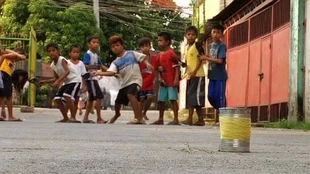
In English 'Knock down the Prisoner', also known as Tumbang Lata 'Knock down the can' or Bato Lata 'Hit the can with a stone'. It is a traditional Filipino children's game, where you get shoes or slipper and try to knock the can down. There is a person that is 'it' and but to decide which person is 'it' the people need to throw there slipper or shoes. The one which is the furthest is the person that is it.
So what the other people are supposed to do is simply knock down the can. When you throw the slipper/shoes you need to quickly retrieve before the tagger/it tag's you. But if you cannot retrieve the slipper, another person will help retrieve it by throwing the slipper. As for the tagger/it, if a slipper lands close to the can, they have to put one of their foot on the can and the other on the slipper near the can. If you get tagged by the tagger/it you will become the new tagger.
Chinese Garter:
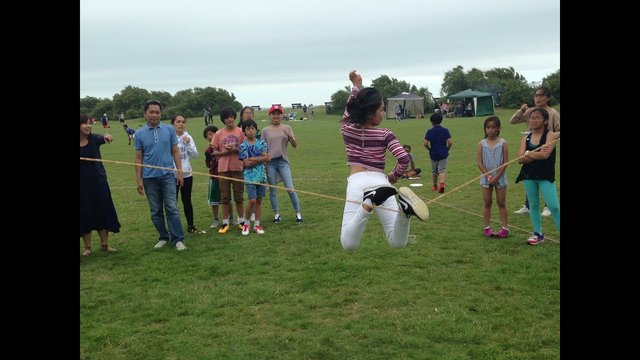
As you can see from the title it says Chinese, but this isn't from China. Chinese Garter is a Philippine traditional game. In this game, you will need to be flexible and you need to be able to jump quite high. So the first thing is we need to have garter or a string, you will need one or you can get one whole string and connect it together to get two strings.
The objective of the game is to crosswise over the garter without being tripped. The Chinese Garter is generally subdivided into ten levels.
Level 1: The garter is near the ground.
Level 2: Knee High
Level 3: Around the height of the hips
Level 4: Waist High
Level 5: Chest High
Level 6: Shoulder High
Level 7: Head High
Level 8: At the tip of the head
Level 9: A couple centimetres over the head.
Level 10: Also known as the mother/father jump, as high as a child raising his/her arms high on tippy toes.
Patintero:
Tumbang Preso:
 |
| Credit: Philippines Wiki - Fandom |
So what the other people are supposed to do is simply knock down the can. When you throw the slipper/shoes you need to quickly retrieve before the tagger/it tag's you. But if you cannot retrieve the slipper, another person will help retrieve it by throwing the slipper. As for the tagger/it, if a slipper lands close to the can, they have to put one of their foot on the can and the other on the slipper near the can. If you get tagged by the tagger/it you will become the new tagger.
Chinese Garter:
 |
| Credit: Steemit |
The objective of the game is to crosswise over the garter without being tripped. The Chinese Garter is generally subdivided into ten levels.
Level 1: The garter is near the ground.
Level 2: Knee High
Level 3: Around the height of the hips
Level 4: Waist High
Level 5: Chest High
Level 6: Shoulder High
Level 7: Head High
Level 8: At the tip of the head
Level 9: A couple centimetres over the head.
Level 10: Also known as the mother/father jump, as high as a child raising his/her arms high on tippy toes.
Patintero:
 |
| Credit: Go Outside and Movement |
Patintero is played on a rectangular grid drawn into the ground. The rectangle is usually 5 to 6 m (16 to 20 ft) in length, and 4 m (13 ft) wide. It is subdivided into four to six equal parts by drawing a central lengthwise line and then one or two crosswise lines. The size of the rectangle and the number of subdivisions can be adjusted based on the number of players. The individual squares in the grid must be large enough that someone can stay in the middle out of reach of someone standing on the lines.
Now you need a few taggers that will go in the line, they cannot move from the line, they can only move sideways. The objective of the game is to run back and forth in the rectangle without getting tagged.


Subscribe to:
Posts (Atom)